

By Gorky

 22/10/2005,
  21:00 23/10/2005, 18:00
director Alvis Hermanis
set and costume designer Monika Pormale
participants Elita Klavina, Regina Razuma, Mara Kimele, Jana Civzele, Maija Apine, Inga Alsina, Gundars Abolins, Alvis Hermanis, Andris Keiss, Andis Strods, Aleksandrs Radzevics, Monika Pormale, Aivars Krastins, Jevgenijs Isajevs
with the assistance of Janis Putnins, Modris Tenisons, Armands Strazds, Juris Poskus, Oskars Poikans
music Armands Strazds
sound Andris Jarans
light, video projection Oskars Plataiskalns
production New Riga Theatre, Latvia
duration2h
national première
In an aquarium or a zoo we can see animals behind glass, in a theatre people, except that the wall separating the audience from the actors is imaginary. In modern zoos the animals are housed in artificial environments, which are supposed to resemble their natural habitat, but in the end they are all boxes. This undeniable fact is brought out perfectly by Laurie Anderson in a song about John Lilly, the man who claims he can talk to dolphins. One day he was swimming in an aquarium and a whale kept asking him the same question, telepathically, over and over again “do all oceans have walls?” (The song is contained on “The ugly one with the jewels”).
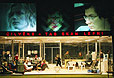
In By Gorky the actors spend most of their time inside a perspex container. Inside we can make out a living room with some haphazard furniture, a kitchen and in the background a bedroom and a fitness room. On top of the container a video screen shows rehearsal footage and testimonies from the actors, another screen shows live footage from inside the container while a third screen shows abstract figures. It's Big Brother all over again indeed, with one minor but crucial difference: in Big Brother, the walls are closed, in By Gorky they are transparent. Big Brother creates the illusion of a natural habitat. By Gorky appears more like a zoo with human inhabitants or like a social experiment for which a natural habitat has been recreated in a laboratory. Glass walls are a very rich metaphor, Walter Benjamin has written extensively about their significance in his Arcades Project, and there is a lot more that one could read into this seemingly simple decision to have the walls of the house made transparent. I am also thinking of Michel Foucault’s Discipline and Punish: The Birth of the Prison here.
By Gorky is loosely based on The Lower Depths, a play by Maxim Gorky, published in 1902, about a dozen or so dropouts who find themselves together in an underground lodging house. It is essentially plotless and concentrates on the characters, each of whom tries to keep up appearances in front of the others.
Alvis Hermanis was born in Riga in 1965. He was trained as an actor at the drama department of the Latvian State Conservatory in Riga, from which he graduated in 1988. He began his career in theatre and film as an actor. Since 1993 he is working at Jaunais Rigas Teatris (New Theatre Riga). Between 1997 and 1999 he was in charge as superintendent and artistic director. Ever since he concentrates on the latter function. At Jaunais Rigas Teatris he has staged more than 20 productions - in some of them he has also been involved as set designer and actor. Some of these productions have been projects for which he has written the dramatic text or adapted a prose work (e.g. Stendhal's About Love, Wilde's The Picture of Dorian Gray). Among the plays staged by Hermanis are The Auditor (Gogol), The Seagull (Chekhov), My Poor Marat (Arbusow), The Town (Grischkowez), Bungee Jumping" (Tätte), Arcadia (Stoppard), The Malady of Death (Duras) and Marquis de Sade (Mishima). Several of his productions have toured abroad and have been shown and decorated at international festivals in Lithuania, Estonia, Poland, Russia, USA, Canada, Austria, Germany, Slovenia, Finland, France, Belgium At Salzburger Festspiele 2003 Hermanis received Young Directors Project Award (Max Reinhardt’s pen). Furthermore, Hermanis has worked as a director in Tallinn and at the opera house in Riga.
New Riga Theatre web site