


Gustavia
Mathilde Monnier/La Ribot
 Teatro Comunale Luciano Pavarotti, Modena
 15/10/2010
,
15/10/2010
,  20:00
20:00
16/10/2010
, 19:00

Created and performed by: Mathilde Monnier, La Ribot
Light design: Eric Wurtz
Sound realization: Olivier Renouf
Stage design realization: Annie Tolleter
Costume design: Dominique Fabrègue
Assisted by: Laurence Alquier
Production: Centre coreographique national de Montpellier Languedoc-roussilon
Coproduction: Festival Montpellier Danse 2008; Centre Pompidou - Les Spectacles Vivants / Festival d'Automne / Théâtre de la Ville - Paris;
Centre de Développement Chorégraphique – Toulouse / Midi-Pyrénées;
Culturgest Lisbonne; La Comédie de Genève; Mercat de les Flors - Barcelone;
La Ribot Genève; Centre Chorégraphique National de Montpellier Languedoc-Roussillon
With the support of Cultures France
For this project, La Ribot is supported by: Pro Helvetia, Swiss Arts Council; Canton of Geneva and the city of Geneva - Département de la Culture;
Running time: 1h
NATIONAL PREMIERE
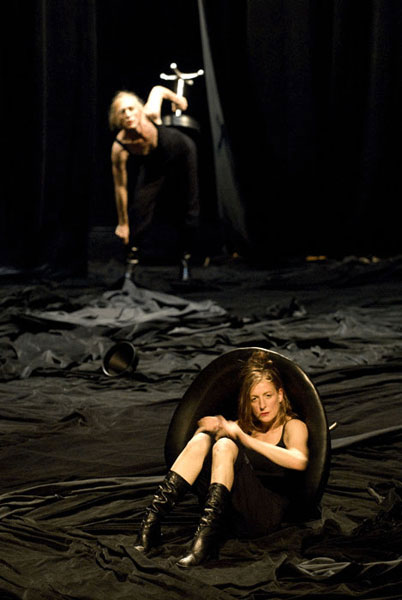
Gustavia is a show that brings together two choreographic artists who have very different backgrounds, but are prompted by similar concerns regarding the future of art, and especially performance art. The show draws on the world of classical burlesque. Classical Burlesque has specific codes and techniques that run through film (Peter Sellers, Tati, Marx Brothers, Keaton, Chaplin, Nanni Moretti...) theater, performance art (Leo Bassi, Anna and Bernard Blume...) as well as the visual arts (Bruce Nauman...).
Burlesque applies techniques of role-reversal and punch-and-dodge; it is an art of transforming incompetence into competence. It distinguishes burlesque heroes from rebel heroes. It emerges from excess speech
as well as from absence of speech. Body-burlesque, however, is rooted in squandered energy, repetition and accident. What is conspicuous in burlesque is hidden in dance, since dance has nothing, or almost nothing, comical about it.
Gustavia is a woman’s name, but really just a stage name. Gustavia tries to talk about important subjects that are over her head; timeless classical subjects such as womanhood, death, theater, performance, self representation, the artist.
Burlesque, not being a genre, provides a framework for the practice of dance, and for modes of thinking and doing. Through an indirect use of burlesque tools, Gustavia tries to freely describe her profession; sidetracks, worries, catastrophes and joys involving the relationship between contemporary art and life.
www.mathildemonnier.com
www.laribot.com
 Mathilde Monnier/La Ribot
Mathilde Monnier received in 1986 the Ministère de la Culture award for Cru at the choreographic competition of Bagnolet. With Jean- François Duroure, she then worked until 1987 on pieces, Pudique acide and Extasis. She has choreographed alone since 1988, Je ne vois pas la femme cachée dans la forêt, Chinoiserie, Pour Antigone. In 1994, she was appointed as director of the Centre chorégraphique national de Montpellier and created Nuit in 1995, L’atelier en pièces in 1996, Arrêtez, arrêtons, arrête in 1997 with the writer Christine Angot, Les lieux de là in 1998/99, choreography in three sections structured with the composer Heiner Goebbels. In 2000, for the festival international Montpellier danse, Mathilde Monnier has invited numerous artists to create an event called Potlatch, dérives which questioned the philosophy of the gift and the debt. Then, she was engaged in doing a diptych Signé, Signés based notably on Merce Cunningham & John Cage’s work. The Royal Swedish Ballet commissioned one of her last piece Natt & Rose. In 2002, she presented Allitérations, a danced conference, with the philosopher Jean-Luc Nancy, for the festival Agora (centre Pompidou – ircam).
In December 02, she created Déroutes based on Lenz from G. Büchner within
the frame of festival d’Automne-Théâtre de la Ville of Paris and Théâtre de
Gennevilliers. In September 03, she was commissioned by the Lyon Opera Ballet
to create Slide with a video maker and a guitarist. She showed in 2004 in the festival Montpellier dance 04 Publique, piece based on the music of the rock star
PJ Harvey. 2005 was marked by two productions: La Place du singe is a duet with
the French writer Christine Angot based on a bourgeoisie issue premiered within
Montpellier danse 05. Frère&soeur was commissioned by Avignon Festival 05 at
the Cour d’Honneur du Palais des Papes. Two years later, she cosignes the show
2008 vallée with the singer Philippe Katerine. In 2007, Tempo 76 an unison
issue was premiered within Montpellier danse 07 with a music of György Ligeti.
In 2008, she was commissioned by the Berliner Philharmoniker conducted by
Sir Simon Rattle to choreograph the Opera Surrogate cities composed by Heiner
Goebbels at the Arena of Berlin.
At the same time, among her filmography, she co-directed with Valérie Urréa,
Chinoiseries and Bruit blanc and then, E pour eux directed by Karim Zeriahen.
In 2004, Claire Denis directed Vers Mathilde, a movie focused on Mathilde
Monnier work. Her contribution in publishing were noticed by the edition of two
books in 2001 : Dehors la danse with the philosopher Jean-Luc Nancy and MW
with Isabelle Waternaux, photographer and Dominique Fourcade, writer. Mathilde
Monnier was distinguished in 99 with the Grand Prix National des Arts du
Spectacle Vivant (national award for the performing arts delivered by the
Ministère de la Culture et de la Communication - France), and received in 2000,
the distinction of Chevalier de la Légion d’Honneur and the Grand Prix de
l’Etoile Dansante, first equal with Heiner Goebbels, awarded by the fundacio Laura
Wolf Andorra (expo Hannover 2000).
www.mathildemonnier.com
La Ribot lived and worked in London from 1997 until 2004. Today she lives in Geneva. Under the diva name of La Ribot, she has created award winning dance pieces that exist at the intersection of contemporary dance, live art, performance and video. In the last decade, La Ribot has created an exacting yet humorous vocabulary of geometric concentration through her renowned dance series istinguished pieces.
La Ribot’s work constitutes a system that allows her to research, develop, and question the temporal, spatial and conceptual limits of dance as it relates to the overlapping fields of live art, performance and visual art. Since 2000, La Ribot has developed a strong interest in the everyday function of video. This has led to the construction of live dance pieces filmed and experienced from the perspective of the body in motion. By presenting her work at major international art galleries, theatres, dance festivals, live art and performance festivals, La Ribot consistently employs dance as a challenge to disciplinary expectation. Experienced live, a La Ribot dance piece creates a paradox of exact uncertainty. This paradox enthralls and draws the viewer into the intensive experience that is La Ribot. As a pioneering figure in the development of dance as live art, La Ribot’s work allows us to understand the changing state of live culture today.
www.laribot.com



Webagency: Web and More S.r.l.
Privacy Policy